- eCom Email Marketer
- Posts
- AI Hit or Flop? 6 Ways AI Actually Wins in Email Marketing
AI Hit or Flop? 6 Ways AI Actually Wins in Email Marketing
Plus, this week's top eCom stories in quick clips.
Q2 is going to find out who actually has their flows dialed in. Get eCom Email Certified for $450 off through Sunday w/ code SPRING → Get Certified
Hey, it's Chase and Jimmy here.
We've been testing AI tools for email marketing over the last year – copy generators, design assistants, segmentation models, send-time optimization, all of it.
Here's what we learned: AI is incredibly good at making you faster. It's terrible at making you interesting.
It can draft 10 subject line variations in seconds, but they all sound like they came from the same template. It can generate email designs quickly, but they look like every other AI-generated email. It can analyze your data and surface patterns, but it can't tell you what to do about them.
The real value of AI isn't in replacing the work. It's in handling the repetitive stuff so you can focus on the parts that actually matter – strategy, creativity, and building genuine connections with your audience.
Today we're breaking down exactly where AI earns its keep in email marketing and where it just wastes your time.
Also inside:
✔️ Spring clean your retention strategy w/ $450 off eCom Email Certified
✔️ Inside the send: How Olaplex makes routine feel like ritual
✔️ Quick clips: This week's top eCom news stories
Let’s dive in.
Spring clean your retention strategy w/ $450 off eCom Email Certified
Q1 is in the rearview. If your email and SMS programs are still running on last year's flows, Q2 is going to expose it (and fast).
That's where eCom Email Certified comes in. It's the only certification built specifically for ecommerce email and SMS marketers, taught by operators who've actually moved the numbers.
What you'll get:
- The retention playbook used by 8 and 9-figure DTC brands
- Frameworks for welcome flows, abandoned cart, post-purchase, and winback
- Segmentation strategies that actually move open rates and revenue per recipient
- Hands-on breakdowns of real campaigns (not theory)
- Lifetime access to the course, updates, and the certified community
It's normally $997. Right now it's $450 off with code: SPRING
This one closes Sunday, April 19th at 11:59 PM PT. After that, it's back to full price.
AI Hit or Flop? 6 Ways AI Actually Wins in Email Marketing
AI is everywhere in email marketing right now. Brands are using it to write copy, generate designs, personalize content, and automate flows. And most of it feels exactly the same.
That's the problem.
AI can be a powerful tool for email marketers, but only if you know where it actually helps and where it just creates more generic noise. The key is using AI to enhance your process without letting it replace the creativity and authenticity that make your brand worth reading.
Here's how to use AI strategically in email marketing without sounding like every other brand in the inbox.
Know where AI actually helps (and where it doesn't)
AI is a double-edged sword. It can streamline processes, speed up production, and surface insights you'd miss manually. But it also creates lazy, forgettable content when you use it as a replacement for thinking.
Here's where AI excels:
Data analysis and segmentation. AI can identify patterns in customer behavior, predict churn, and surface high-value segments faster than any human could. Use it to understand what's happening in your data, not to tell you what to do about it.
Design ideation and iteration. Tools like Gemini can draft visual concepts quickly, which means you can test more ideas faster. But you still need human oversight to make sure the designs align with your brand and actually work.
Process automation. AI can handle repetitive tasks like A/B testing subject lines, optimizing send times, and populating dynamic content blocks. This frees up your time for the strategic work that actually moves the needle.
Here's where AI falls flat:
Writing authentic copy. AI-generated copy sounds generic because it's trained on generic inputs. It doesn't understand your brand voice, your customers' inside jokes, or the nuance that makes messaging memorable. Use AI for research and ideation, not final drafts.
Making strategic decisions. AI can't tell you whether an offer is right for your brand or if now is the time to send it. Those are judgment calls that require understanding your business, not just your data.
Creating emotional connection. The best email marketing feels personal. AI can't replicate empathy, humor, or the human touch that builds relationships.
Use AI where it's strong. Lean on your own judgment everywhere else.
Use AI for design speed, not design quality
AI design tools can generate concepts in seconds, which is useful for brainstorming or testing multiple directions quickly. But speed doesn't equal quality.
The workflow that works: use AI to draft visual ideas, then let a designer refine them. AI gets you to the first 60-70% faster, but the last 30% is what makes a design actually good. That's where human judgment, brand alignment, and aesthetic sensibility come in.
If you're using AI to skip the designer entirely, your emails are going to look like AI-generated emails. And people can tell.
Let AI assist your copywriting, not replace it
AI can help with research, idea generation, and drafting variations. But it shouldn't be writing your final copy.
Here's a better workflow:
Use AI to generate 10 different subject line angles, then pick the best one and rewrite it in your voice
Ask AI to outline a campaign structure, then write the actual emails yourself
Feed AI your past high-performing emails and ask it to identify patterns, then apply those insights to new campaigns
The key is keeping AI in the assistant role. It can speed up your process, but it can't replace the creativity and brand knowledge that make copy actually convert.

Build non-promotional, interactive campaigns that drive engagement
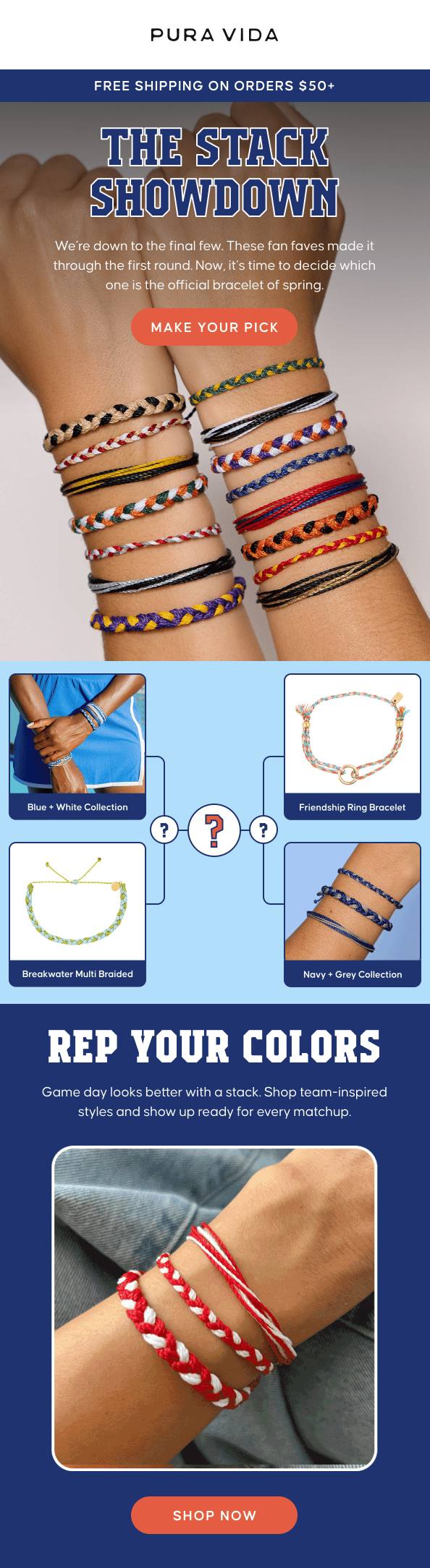
One of the most effective strategies in email marketing right now is non-promotional, click-based campaigns. These aren't sales emails. They're interactive experiences that engage people and build affinity without asking for a purchase.
Here's an example: create a flowchart-style email that guides readers through a series of relatable choices. Each click takes them to a new page or result that feels personalized to their answers. It's interactive, it's fun, and it gets people engaging with your brand without feeling like they're being sold to.
This works because:
It's different from the promotional emails flooding their inbox
It creates a personalized experience without heavy data requirements
It builds engagement and brand affinity, which pays off in future campaigns
People are more likely to click when it's not tied to a purchase decision
The key is making the content emotionally resonant and genuinely interesting. If it feels like a quiz just to collect data, people won't engage. But if it feels like something they'd actually want to do, click-through rates skyrocket.

Capitalize on cultural moments when attention is available
Timing matters. There are moments when people are distracted, bored, or actively looking for something to do. That's when your emails have the best shot at cutting through.
One example: the Super Bowl halftime sale. During halftime, millions of people are on their phones, disengaged from the game, and open to distractions. A well-timed email with a short-window offer can drive massive engagement because you're reaching people when they're already looking for something to do.
This strategy works for any cultural moment where attention is available:
Halftime during major sports events
Commercial breaks during big TV finales
Waiting periods during live events
Downtime during holidays or long weekends
The trick is identifying when your audience is most receptive and timing your send accordingly. Don't just send when it's convenient for you. Send when they're actually paying attention.
Use recent data, not old data
A lot of brands are feeding AI models with historical data from the last year or two, hoping to uncover insights. The problem? Old data reinforces old strategies, and customer behavior changes fast.
Instead, focus on recent data from the last 30, 60, or 90 days. This gives you a more accurate picture of what's working right now, not what worked six months ago.
AI is great at analyzing large datasets quickly, but if you're feeding it stale data, you're just automating outdated tactics. Use AI to analyze recent behavior, identify emerging patterns, and adjust your strategy in real time.
Prepare for AI-powered inboxes and personal assistants
Email marketing is about to get more complicated. As AI-powered personal assistants become more common, you might not be writing just for human readers anymore. You'll be writing for AI agents that filter, prioritize, and summarize emails on behalf of users.
What does that mean for email marketers?
Clarity and structure matter more than ever. If an AI assistant is scanning your email to decide whether it's worth showing to the user, vague or overly clever copy won't work. You need clear subject lines, structured content, and obvious value propositions.
Personalization becomes even more critical. Generic emails will get filtered out. Emails that feel relevant and timely will make it through.
Data quality and segmentation become competitive advantages. The better your data, the more targeted your messaging, the more likely you are to bypass AI filters and reach the actual person.
This shift is coming. The brands that prepare now will have an advantage over the ones that ignore it.
Use AI to enhance your process, not replace your thinking
AI is a tool. It can make you faster, more efficient, and more data-driven. But it can't replace the strategic thinking, creativity, and brand knowledge that make email marketing actually work.
Here's the right way to use AI in email marketing:
Let AI handle repetitive tasks so you can focus on strategy
Use AI to surface insights from data, then make decisions based on your judgment
Ask AI to generate ideas and variations, then refine them in your voice
Use AI to speed up design and copywriting processes, but keep humans in the loop for quality control
Winning with AI isn't about automating everything. It's about using it strategically to enhance what you're already doing well. The human element is still what makes email marketing effective. AI just makes the process faster and smarter.
Don't let AI write your emails. Let it help you write better emails.
Inside the send: How Olaplex makes routine feel like ritual
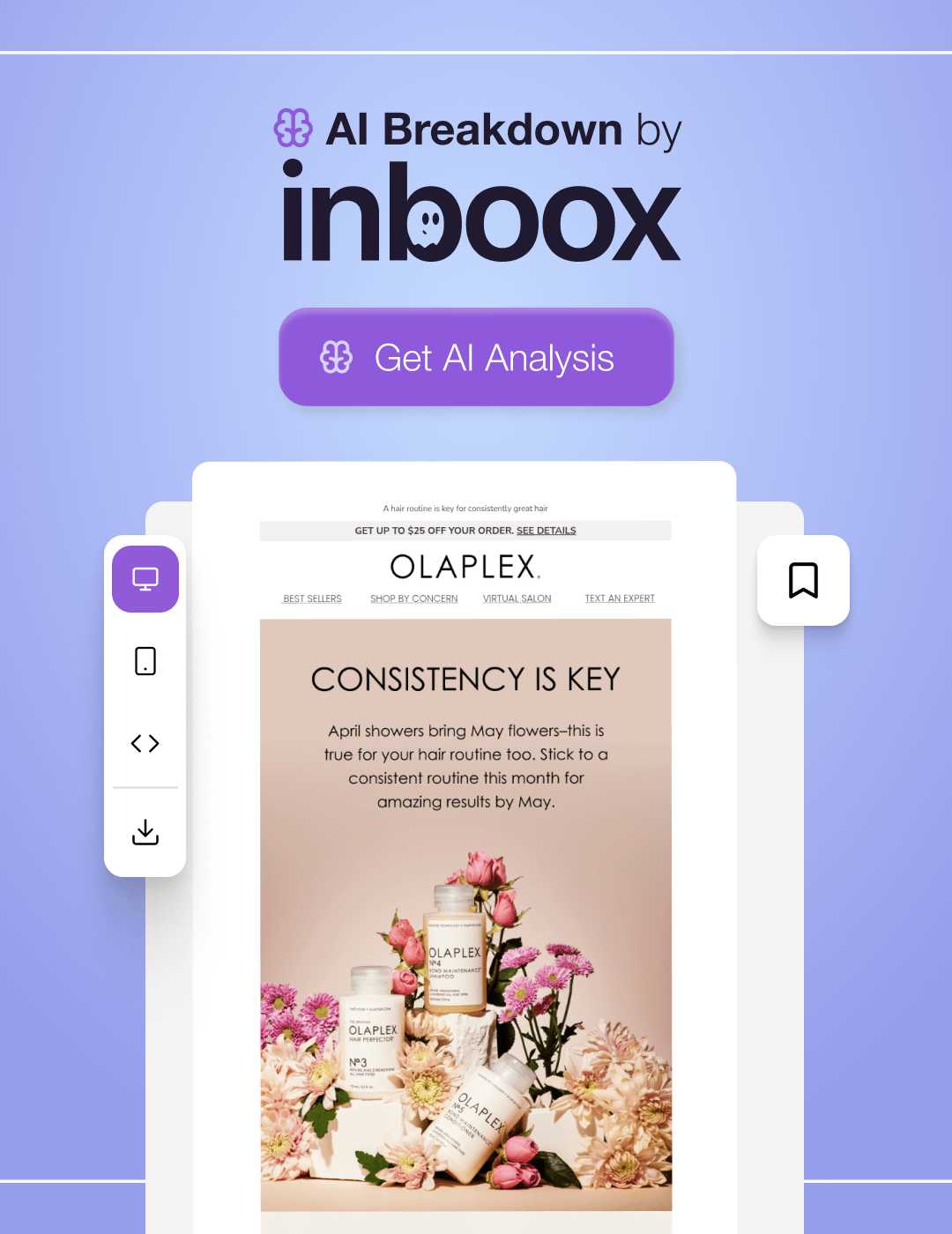
Inboox's AI Breakdown unpacked this seasonal routine email and found what clicked:
"Consistency is Key" hook that taps into real customer behavior (not just product pushing)
Step-by-step visual layout that makes a multi-product routine feel doable, not overwhelming
Footer stacked with bundles, discounts, and social links; multiple paths to convert
It also spotted easy wins like sprinkling in customer testimonials to add proof, highlighting results per product (not just steps), and sharpening mobile optimization so it looks just as good on the scroll.
That's the power of Inboox. Access 1.5M+ real Shopify emails, get instant AI breakdowns on what works (and what doesn't), plus send-time data, full HTML, and more.
Quick Clips:
Another fee on your Amazon bill: Amazon is adding a 3.5% fuel and logistics surcharge to FBA fees starting April 17, averaging about $0.17 per unit; and sellers have no great alternatives since UPS, FedEx, and USPS are all doing the same. The bigger concern? Amazon pulled a similar "temporary" surcharge in 2022 and eventually rolled it into standard fees permanently, so don't count on this one going away.
Retailers have a tariff cheat code & (shocker) Congress wants it gone: The "First Sale" rule lets importers pay duties based on the original manufacturer price rather than the final sale price, which can mean a huge difference when middlemen are involved. It's been legal for decades, but a new bipartisan Senate bill wants to close what critics call a loophole; while retailers argue it's a transparency-promoting, fully legal cost management tool.
Vacation's got a big new backer: Sun care brand Vacation just landed a $70M investment from VMG Partners (the same firm that backed Sun Bum before its $400M exit) at a $210M valuation. The brand has serious buzz and a cult following, but analysts say the real test is whether it can move from vibe to everyday staple in a category that's increasingly won on formulation, not just aesthetic.
Annnnd that’s a wrap for this edition!
Thanks for hanging with Chase and me. Always a pleasure to have you here.
If you found this newsletter helpful (or even just a little fun), don’t keep it to yourself! Share ecomemailmarketer.com with your favorite DTC marketer. Let’s get them on board so they don’t miss next week’s drops.
Remember: Do shit you love.
🤘 Jimmy Kim & Chase Dimond
PS - Your next best customer might be reading this right now. Want in? Email Jimmy to sponsor this newsletter and more.
Love this newsletter but want to receive it less frequently? Let us know by clicking here!
Reply