- eCom Email Marketer
- Posts
- Fri 8/28 | Ed 403 | The seasons your marketing calendar is missing
Fri 8/28 | Ed 403 | The seasons your marketing calendar is missing
🌊 About three weeks out and the room is nearly full. Commerce Roundtable takes over San Diego Sept 21-22! → Use EEMVIP to save 40%
Back-to-school came and went, and if you don't sell backpacks you sent nothing.
Fair enough, it isn't your holiday.
But "not my holiday" is how brands end up with two loud months and ten quiet ones, shouting through Black Friday and New Years and going dark while their customers keep having fresh starts nobody shows up for.
New term, new season, new gym, new apartment. Every one of them is somebody's reset and most belong to nobody.
So today: how to find the selling seasons hiding in your calendar's dead zones, and how to sell into a moment your product has nothing to do with. 👇
Also inside:
→ Recovered revenue that sounds like a whole retention team, run by one agent
→ The 20-minute habit Chase runs before writing any campaign
→ Why your best-performing email quietly stops working
→ The activewear brand that crossed a billion and immediately hit the gas

For a long time, adding a recovery channel meant adding people to run it. Voice meant a call center. Every new touchpoint was another hire, or another line on the agency invoice.
Outcraft AI flips that math. One voice agent calls abandoned checkouts, upsells post-purchase, chases replenishment, and asks for reviews all while coordinating the SMS and email follow-up from the same brain.
That's work that used to take a team, run by one person pointing an agent at the moments that matter.
The most leveraged retention programs we see now pair a small team with an agent doing the outreach a whole department used to.
→ Hear what recovered revenue sounds like at Outcraft AI
*Sponsored
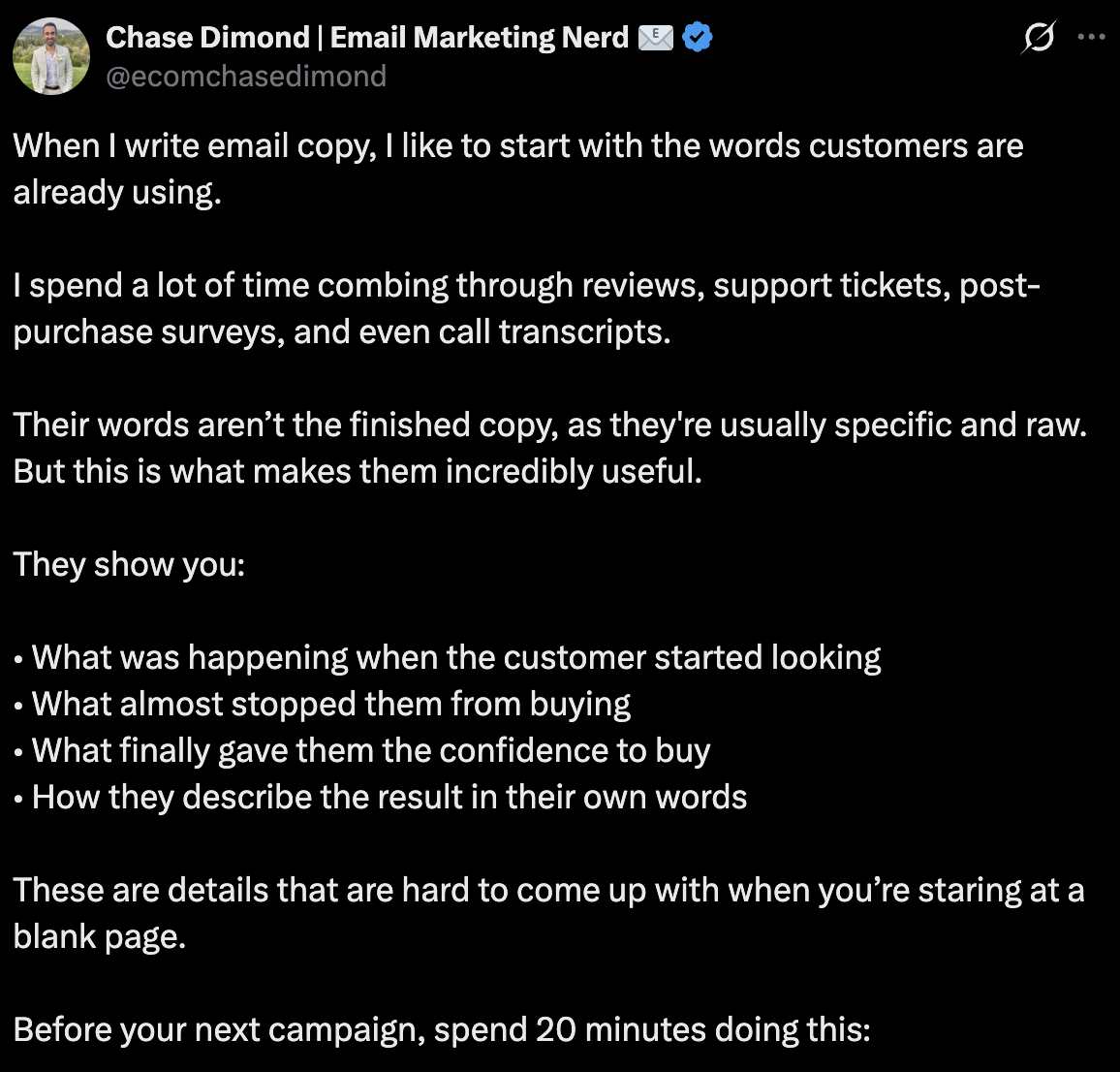
Your best email copy is already written, by your customers.Chase breaks down the 20-minute habit he runs before every campaign.
Pull up your send calendar and zoom out.
For most brands, there are a few obvious spikes. Black Friday lights up. New Year gets another push. Maybe there’s a product-specific holiday somewhere in between. Then you hit long stretches where the calendar gets a whole lot quieter.
Those stretches are some of the most expensive space you own, because your customers didn’t stop changing their routines, priorities, or spending habits just because there wasn’t a major shopping holiday on the calendar.
They’re constantly moving into new seasons of their lives. Your marketing just needs to catch up.
The opportunity is to stop looking exclusively for holidays and start looking for moments.
A good moment has two things working in your favor: a built-in emotion and a natural deadline. And there are far more of them throughout the year than the handful of dates most brands already circle.
The trick is finding the behavior change underneath the date and figuring out where your product naturally fits.
Find the reset your customer is already going through
Back to school looks like Target’s moment. But underneath the backpacks, notebooks, and dorm shopping, something much bigger is happening: millions of people are resetting their routines at the same time.
That creates openings for brands that have absolutely nothing to do with school supplies.
A coffee brand can own the return of the 6 a.m. wake-up. A skincare brand can build a campaign around getting the fall morning routine back together. A pet brand can speak to the dog that suddenly has an empty house again after a summer full of people.
None of them sell a backpack. They’re selling into the behavior change happening around it.
And even within one moment, you have multiple audiences experiencing that shift differently:
Parents: getting the household back on a schedule
College students: building an entirely new routine
Teachers: heading back into their busiest season
Adults without kids: tapping into that strangely universal September “fresh start” feeling

One six-week window can give you four different messages without inventing four different occasions to send.
That’s the mindset: stop asking whether the holiday belongs to your product and start asking whether the behavior around it does.
Run one test before you commit to a moment
You also don’t need a 15-step framework to decide whether a moment makes sense for your brand.
Try putting the connection into a subject line.
If it makes sense immediately, you probably have something. “Reset your morning routine” doesn’t need a paragraph of explanation before the customer understands why they’re seeing it.
If you need three sentences to justify why your candle brand is suddenly talking about the first day of school, you’re probably forcing it.
Drop that one. There will be another moment.

The goal isn’t to attach your brand to every date on the calendar. It’s to get better at recognizing the handful of shifts throughout the year where your product already has a natural role to play.
Let the moment do the work your discount usually does
This is where moments get especially useful.
When the timing itself gives people a reason to act, you don’t have to manufacture urgency with another 40% off sale. There’s already a reason to get something done now rather than someday.
Instead of leading with price, build the campaign around the reset:
Package best sellers into a bundle that solves for the new routine.
Merchandise products around what the customer is trying to do differently.
Use the moment itself as the reason to buy now.
Save the discount for the people who still haven’t moved.

That gives you somewhere to go besides immediately cutting price.
It can also make for a much stronger reactivation campaign. “We miss you, here’s 15% off” doesn’t give a lapsed customer much of a reason to care. A message tied to something currently changing in their life gives you a new way back into the conversation.
Build the muscle you can use all year
Back to school is nearly over, but that’s actually the point.
There’s another reset right behind it... then another.
Fall routines turn into holiday hosting. Holiday chaos turns into January resets. Winter turns into spring cleaning, travel planning, outdoor season, wedding season, summer Fridays, vacations, back to school, and eventually Q4 all over again.
You don’t need to own all of them.
You need to identify the ones where your customer’s behavior changes in a way that makes your product suddenly more useful, relevant, or timely.
Once you start looking at the calendar that way, the year stops being Black Friday, New Year, and a bunch of filler in between.
It becomes a series of smaller buying seasons you can actually build around.
Steal this today
Look at the next reset your customer is heading into this fall and ask one question:
What are they about to start doing differently?
Then:
Pick one behavior change that naturally connects to your product.
Build a simple “reset your routine” bundle from products you already sell.
Send it to your engaged segment without leading with a discount.
Watch clicks, conversion, and product mix to see whether the moment actually landed.
You don’t need a six-week campaign to prove the idea. Start with one afternoon and one send.
If it works, you may have just found a selling season you didn’t know you had.
It crushed in April, so it became the template. Every send since, the numbers have slipped a little, never enough to trigger a meeting. Your list isn't tired of email. It's tired of that email.
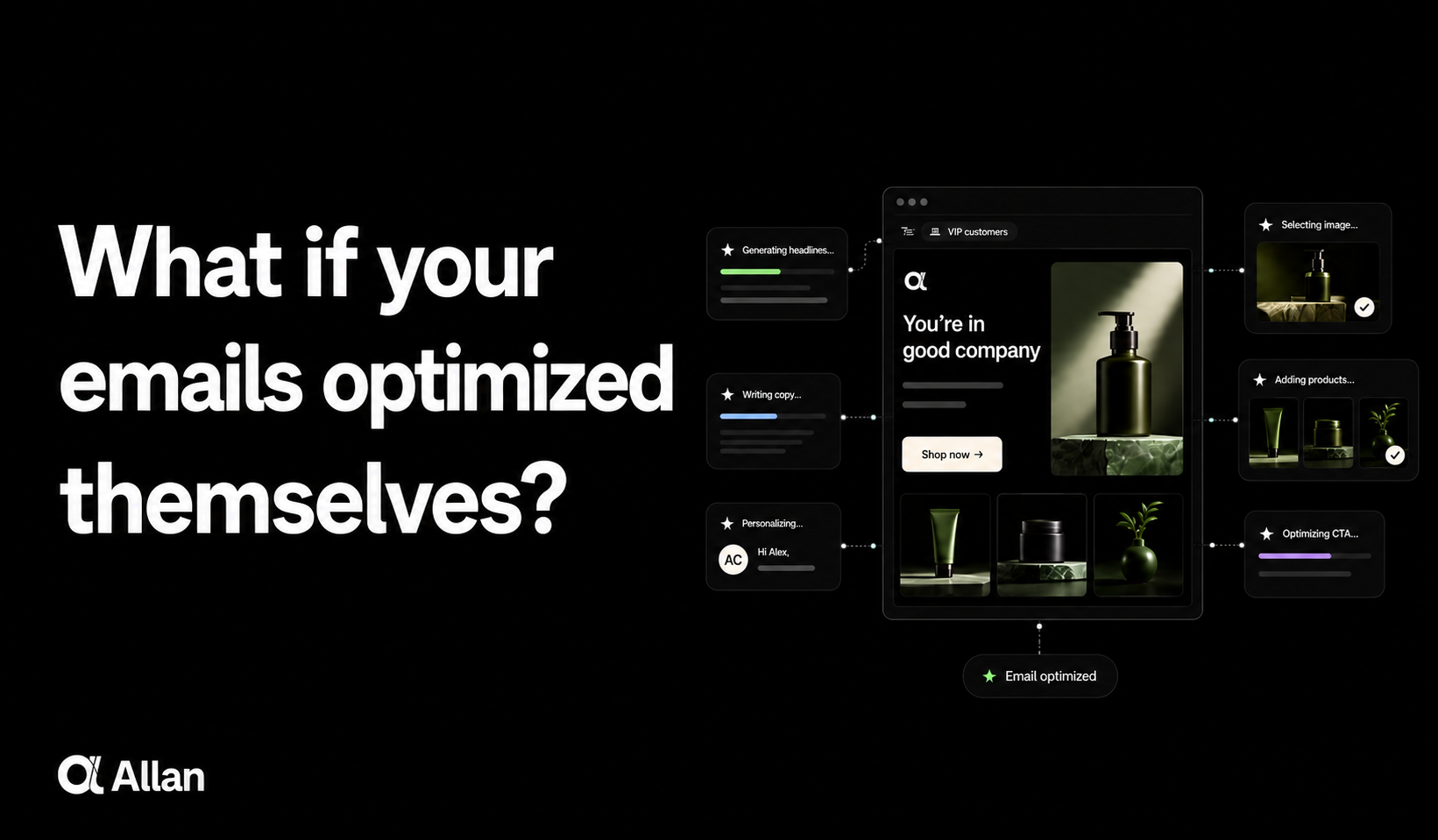
Paid media treats creative fatigue as a law of physics. The algorithm watches every combination, retires what's cooling, and rotates in the next one, per person, automatically. In email, a fading winner has to be spotted, rebuilt, and retested by hand, so it underperforms for months before anyone acts.
Allan gives email that reflex. On top of your Klaviyo, it assembles a fresh combination for every subscriber at send time and rotates out what's fading on its own.
*Sponsored
Fabletics just crossed $1 billion in net revenue and is tripling its international footprint, opening 45 new stores in the next year, on the strength of the membership base it's compounded for a decade.
Those members pay monthly, bank credits, and keep coming back on their own, giving Fabletics the kind of predictable, recurring revenue most DTC brands would kill for right now.

Reply