- eCom Email Marketer
- Posts
- How to use AI without sounding like every other brand
How to use AI without sounding like every other brand
Plus, this week's top eCom stories in quick clips.
50 campaigns, 130+ pages of welcome flows, and 10 copywriting frameworks. Everything you need to stop guessing and start driving retention. → Unlock the Vault
Hey, it's Chase and Jimmy here.
AI tools are useful for brainstorming subject lines, drafting campaign copy, and speeding up your workflow.
But here's the problem we keep seeing: brands are letting AI write everything, and now their emails sound exactly like every other brand in the inbox.
Generic subject lines. Flat SMS messages. Welcome flows that could've been written by anyone.
AI is a useful tool, but it's not good at being you. Today we're breaking down how to use AI strategically without losing the voice that actually makes your brand worth paying attention to.
Also inside:
✔️ The retention playbook that took 15 years and $200M to build. Yours for $27.
✔️ Clicked send too soon? You can finally cancel campaigns mid-flight.
✔️ Quick clips: This weeks top eCom new stories
Let’s dive in.
The retention playbook that took 15 years and $200M to build. Yours for $27.
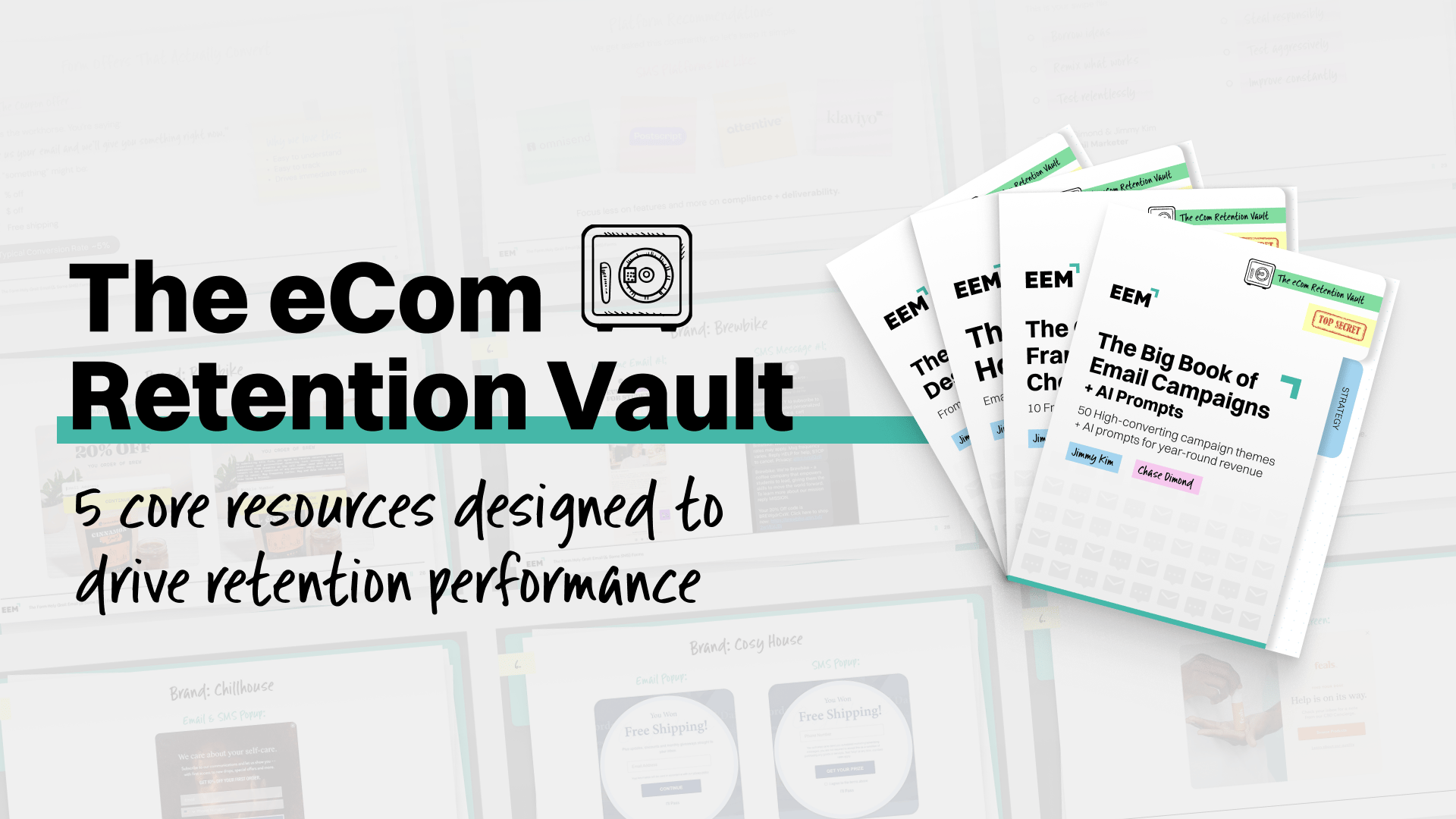
Most email marketers aren't losing because they lack talent. They're losing because they're figuring out from scratch what the best brands already know.
After 15+ years and $200M+ in email and SMS revenue, we just bottled it all up. The campaigns that drive the most revenue. The welcome flows that actually convert. The frameworks, the design principles, the AI prompts. Everything.
The eCom Retention Vault is the unlock.
50 proven campaigns with real brand examples and AI prompts. 130+ pages of welcome flows. 10 copywriting frameworks. Design secrets pulled from 10,000+ high-performing campaigns. Lifetime access to a private community of 350+ retention marketers.
One time. $27. Lifetime access.
Stop figuring out what already exists.
How to use AI without sounding like every other brand
AI is everywhere in marketing right now. And let's be honest, we're all guilty of using it to write subject lines, draft campaign copy, or brainstorm ideas for our next send.
That's not the problem.
The problem is when AI becomes the voice of your brand instead of just a tool in your process. When every email starts to sound the same. When your SMS messages could've been written by anyone. When customers can't tell the difference between you and the dozen other brands in their inbox.
That's where things start to break down.
Here's how to use AI strategically in your retention marketing without losing what makes your brand actually sound like you.
The real risk isn't AI itself, it's lazy execution
AI tools are incredibly useful. They can speed up your workflow, help you get unstuck, and surface ideas you wouldn't have thought of on your own.
But they're not good at being you.
They don't know your customer's inside jokes. They don't understand the specific way your audience talks about their problems. They can't replicate the tone that made someone fall in love with your brand in the first place.
When you use AI as a replacement instead of an assistant, your marketing starts to sound generic. And generic doesn't build loyalty. It doesn't drive retention. It just blends into the noise.
Start with your brand voice, not the AI prompt
Before you even open ChatGPT or Claude, you need to be clear on what your brand voice actually is.
Not just "friendly" or "professional." That's not specific enough.
Ask yourself:
If your brand were a person, how would they text a friend?
What words or phrases does your audience use that you should mirror?
What topics does your brand have strong opinions about?
What would your brand never say, even if it's trendy?
Write this down. Document it. Make it something you can reference and share with your team.
Once you have that foundation, AI becomes a tool that helps you execute faster. Without it, AI is just writing in its own voice, and that voice sounds like everyone else's.
Use AI to generate options, not final copy
Here's a better workflow: let AI do the heavy lifting on ideation, then rewrite it in your voice.
For example, if you're stuck on a welcome series:
Don't do this: Prompt AI to "write a 5-email welcome series" and copy-paste the results.
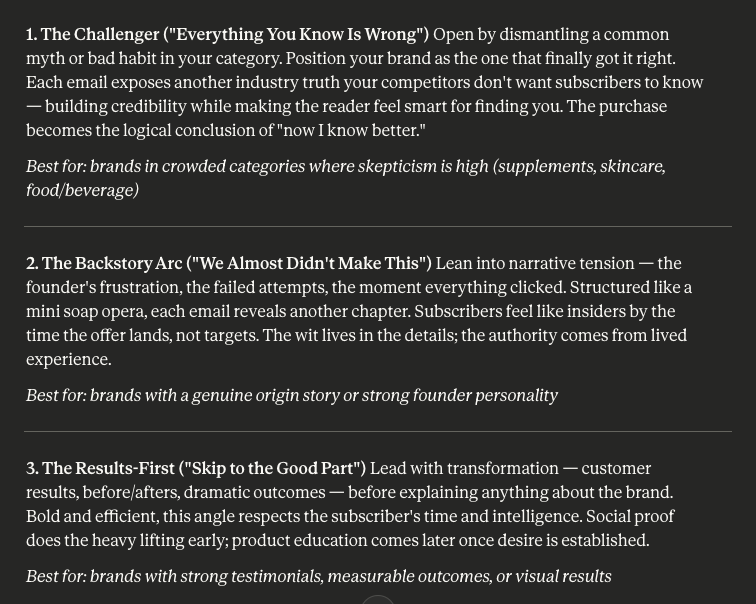
Do this instead: Ask AI to outline five different angles you could take in a welcome series. Pick the one that feels most aligned with your brand. Then write the actual emails yourself, using AI only to refine specific lines or test variations.
The same applies to subject lines, SMS copy, and campaign ideas. Use AI to get you 80% of the way there, then add the 20% that makes it sound like you.
Train AI on your voice (but don't let it replace your judgment)
Most AI tools let you feed them examples of your writing. Use that.
Give the AI:
Past emails that performed well
SMS messages customers actually responded to
Campaign copy that felt distinctly "you"
Customer reviews or testimonials that use language your audience relates to
When you do this, the AI's output gets closer to your actual voice. But it's still not perfect. You still need to edit. You still need to inject personality. You still need to make judgment calls that an algorithm can't.
Think of it like hiring a junior copywriter. They can draft something based on your style guide, but you wouldn't publish it without review. Same rules apply here.
Know where AI works best (and where it falls flat)
AI is great for certain tasks. It's terrible at others. Knowing the difference keeps you from over-relying on it in the wrong places.
Where AI actually helps
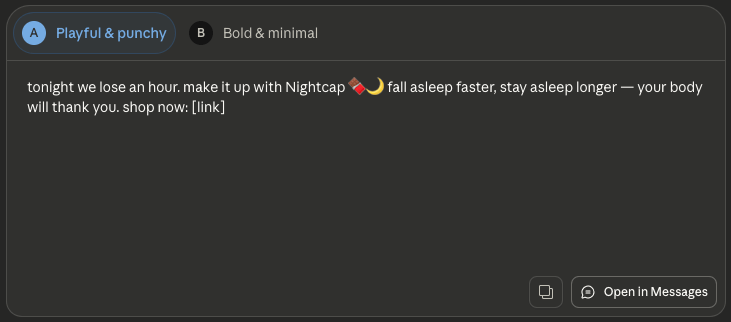
Brainstorming angles for campaigns. When you're stuck on how to frame an offer or what angle to take, AI can surface ideas quickly.
Writing variations for A/B tests. Need five different subject lines to test? AI can generate them fast.
Drafting structure and outlines. Use it to map out email flows, sequence logic, or campaign calendars.
Repurposing content. Turn a blog post into email bullets or condense a long message into SMS-friendly copy.
Where AI struggles
Understanding nuance in your audience. AI doesn't know your customers the way you do. It can't pick up on subtle shifts in tone that matter.
Creating genuinely funny or clever copy. Humor is hard to automate. What AI thinks is funny usually isn't.
Building emotional connection. The best retention marketing feels personal. AI-generated empathy usually falls flat.
Making strategic decisions. AI can't tell you whether an offer is right for your brand or if now is the time to send it.
Use AI where it's strong. Lean on your own judgment everywhere else.
Protect your tone in high-touch moments
Some emails and texts are too important to automate or over-rely on AI.
These include:
Welcome series. This is someone's first impression of your brand. It needs to feel intentional, not templated.
Apology or service recovery emails. When something goes wrong, people can tell if the response is generic. Write these yourself.
VIP or high-value customer communications. Your best customers deserve messaging that feels considered, not auto-generated.
Post-purchase follow-ups. These emails set the tone for the relationship. Make them count.
For these moments, use AI sparingly. Maybe it helps you draft an outline or test a subject line. But the final copy should come from you.
Build guardrails into your process
If multiple people on your team are using AI, you need rules. Otherwise, your brand voice will drift without anyone noticing.
Set clear guidelines:
AI is for drafting, not publishing. Nothing goes out without a human reviewing and editing it.
Always personalize the output. If it sounds like it could've come from any brand, rewrite it.
Flag AI-generated copy in your workflow. Make it visible when something was drafted by AI so reviewers know to scrutinize it more closely.
Review tone regularly. Every quarter, audit a sample of your emails and SMS messages. Do they still sound like you? If not, tighten the process.
These guardrails are all about making sure speed doesn't come at the cost of quality.
Test real engagement, not just efficiency
AI can help you send more emails faster. But more emails don't always mean better results.
If your open rates are dropping, your click-through rates are flat, or people are unsubscribing more than usual, speed isn't the issue. Relevance is.
Pay attention to:
Reply rates. Are people actually responding to your messages, or are they just opening and ignoring?
Unsubscribe trends. A sudden spike might mean your tone has shifted and people don't recognize you anymore.
Qualitative feedback. What are customers saying when they do reply? Does it sound like they're connecting with your brand or just tolerating your emails?
Efficiency matters. But engagement matters more. Don't let AI help you send mediocre messages faster.
Remember why your brand voice exists in the first place
Your voice isn't just a style choice. It's how you build trust, create connection, and differentiate yourself from everyone else selling similar products.
When someone reads your email, they should know it's from you before they even see the logo. That's the standard.
AI can help you get there faster. It can make your process smoother. It can free up time for the strategic work that actually moves the needle.
But it can't replace the thing that makes your brand worth paying attention to in the first place.
Use AI as your co-pilot, not your replacement
AI isn't going anywhere. And honestly, you shouldn't avoid it. The brands that figure out how to use it well will have a real advantage in speed, testing, and iteration.
But the brands that lean too hard on it will start to sound indistinguishable from each other. And in a crowded inbox, indistinguishable is forgettable.
Here's what to remember:
Be clear on your brand voice before you ever touch AI
Use AI to generate ideas and drafts, not final copy
Train AI on your voice, but don't trust it blindly
Know where AI helps and where it falls short
Protect high-touch moments from over-automation
Build guardrails so quality doesn't slip
Measure engagement, not just output
Do that, and AI becomes a tool that makes you better. Not a crutch that makes you generic.
Your customers don't need another brand that sounds like everyone else. They need you to sound like you. AI can help with that. Just don't let it do all the talking.
Clicked send too soon? You can finally cancel campaigns mid-flight.
Omnisend's March updates tackle the small gaps that quietly break workflows; deleted segments that kill automations, invisible forms, sketchy-looking links, and the dreaded "oh no" moment right after hitting send on a campaign.
Here's a look at what's new:
Catch a typo or wrong link before emails? Cancel campaigns before they fully deliver
Get alerts when someone deletes a segment your automation depends on
Stop hunting through themes, set up embedded Shopify forms w/ guided flow
See which products your automations are actually selling, not just total revenue
Wave bye-bye to generic Omnisend links with new custom link domains
Check the public roadmap to see what's being built, what's planned, and what's in beta
Quick Clips:
Ulta's TikTok era begins: Ulta is launching on TikTok Shop next week with a curated assortment of brands you can only find at Ulta; a smart move as beauty continues its migration online. Q4 was strong with net sales up nearly 12%, but analysts are raising an eyebrow at softer 2026 comp guidance, even if leadership thinks it's just the hangover from a big year.
Shopify's betting big on your AI personal shopper: Shopify president Harley Finkelstein says agentic commerce is the biggest shift the company has ever prepared for; and the pitch is compelling: agents that actually know your preferences and surface the right brands, not just the biggest ad spenders. Only 18% of U.S. retail is online right now, and he thinks agents are the unlock for the other 82%.
YouTube out-earned Hollywood: YouTube pulled in $40.4 billion in ad revenue in 2025, topping the combined haul from Disney, NBC, Paramount, and Warner Bros. Discovery. A year prior it was the other way around, so this isn't just a milestone, it's a flip. Advertisers are following eyeballs, and younger audiences are spending them on YouTube.
David Protein's got a macro problem: A proposed class action claims David Protein bars have nearly double the calories and up to 4x the fat listed on the label, based on independent lab testing. The founder is pushing back on the testing methodology, arguing the FDA requires different calculations for the ingredients they use.
Annnnd that’s a wrap for this edition!
Thanks for hanging with Chase and me. Always a pleasure to have you here.
If you found this newsletter helpful (or even just a little fun), don’t keep it to yourself! Share ecomemailmarketer.com with your favorite DTC marketer. Let’s get them on board so they don’t miss next week’s drops.
Remember: Do shit you love.
🤘 Jimmy Kim & Chase Dimond
PS - Your next best customer might be reading this right now. Want in? Email Jimmy to sponsor this newsletter and more.
Love this newsletter but want to receive it less frequently? Let us know by clicking here!
Reply