- eCom Email Marketer
- Posts
- The eCommerce email playbook for 2026
The eCommerce email playbook for 2026
What do marketers call the place abandoned carts go? The Inboox 👻 Access the AI-driven database w/ over 1.5M real emails & insights.
Good morning, Chase and Jimmy here.
Email still drives a huge share of ecommerce revenue, but this year, the margin for error is thinner than ever. Customers are quicker to tune things out, inbox rules are stricter, and not every email earns its place anymore.
Today’s article breaks down which emails actually pull their weight, where restraint matters more than volume, and how to think about your email mix so it keeps working long term.
Also inside:
✔️ 2025 Rewrote deliverability. 2026 Will enforce it.
✔️ How to leverage knowledge, service, and story to outsmart the giants
✔️ DTC wins: Cymbiotika enters the creatine game with liposomal packets
Let’s get into it.
2025 Rewrote deliverability. 2026 Will enforce it.

Inbox providers rolled out stricter rules, faster enforcement, and far less room for error. In this live session, Omnisend breaks down what actually changed last year, what’s coming next in 2026, and how brands should adjust now to protect inbox placement before it becomes a problem.
You’ll learn:
The 2025 deliverability updates that matter most
What inbox providers are signaling for 2026
How to adapt your sending strategy before penalties hit
👉 Save your seat and join Omnisend on 1/27 @ 7:00 AM PT to get ahead of inbox changes
The eCommerce email playbook for 2026
Email still drives a massive share of ecommerce revenue. That hasn’t changed.
What has changed is how much margin for error there is. Customers are sharper. Inbox filters are stricter. And every unnecessary send chips away at trust, engagement, or deliverability.
The brands seeing results in 2026 aren’t sending more email. They’re making better decisions about which emails earn the send in the first place.
This is the email mix that actually holds up today, and how to think about each one strategically.
1. Welcome emails set expectations, not just conversions
Your welcome email does more than introduce your brand. It trains your subscriber on what being on your list feels like.
This is where customers subconsciously decide:
How often they’re willing to hear from you
Whether your emails feel useful or noisy
And whether you’re worth paying attention to later

A strong welcome email clarifies value early. It explains what kind of content you send, how often it shows up, and why staying subscribed benefits them. Incentives can help, but trust is the real conversion here.
If your welcome email overpromises or immediately pushes too hard, everything that follows becomes harder.
2. Abandoned cart emails help remove friction, not apply pressure
Cart abandonment emails still work because intent already exists. Someone wanted the product. Something just got in the way.
The mistake brands make is assuming that intent gives permission to nag.
Strong cart emails focus on removing friction:
Clear product reminders
Shipping and return reassurance
Simple paths back to checkout

Weak cart emails rely on false urgency, excessive discounts, or too many follow-ups. High intent doesn’t mean unlimited tolerance. One to two well-timed reminders almost always outperform longer, more aggressive sequences.
3. Browse abandonment emails should be optional, not automatic
Browse abandonment is one of the easiest flows to overuse.
Not every page view signals intent. Casual browsing, comparison shopping, or inspiration scrolling doesn’t always deserve a follow-up email. When browse emails work, it’s because behavior shows depth, not volume.
They perform best when tied to:
Repeated views of the same product
Long time spent on a PDP
Known purchase history in that category

When sent broadly, they add noise. When sent selectively, they feel helpful. Treat browse emails like a precision tool, not a default.
4. Product launch emails sell context before features
Most launch emails fall flat because they assume “new” is enough to earn attention.
It isn’t.
Subscribers don’t open launch emails hoping to read a spec sheet. They want to understand where this product fits in their life and why it’s relevant right now. Context does the heavy lifting here, not novelty.
The strongest launch emails:
Anchor the product in a real scenario or problem
Explain who it’s for (and who it’s not)
Use visuals to show the outcome, not just the product
Reserve early access or priority windows for your most engaged customers

A good launch doesn’t try to impress everyone. It helps the right people recognize themselves quickly and decide if this is for them. When that’s clear, conversion follows without forcing urgency.
5. Post-purchase emails protect the first experience
Retention starts after the receipt.
Post-purchase emails aren’t just transactional. They reduce regret, increase product success, and shape whether someone buys again. Education here matters more than promotion.
Strong post-purchase emails:
Show customers how to use what they bought
Reinforce why they made a good decision
Set expectations around shipping, care, or next steps

Silence after purchase leaves room for doubt. Thoughtful follow-up builds confidence.
6. Re-engagement emails are a judgment call, not a growth lever
This is where thinking has shifted the most.
Re-engagement emails can still work, but they can also hurt more than help if used carelessly. Inbox providers are watching engagement signals closely, and repeatedly emailing long-term inactives sends the wrong ones.
A smart re-engagement approach is:
Short
Permission-based
Easy to opt out of

If you need more than two or three emails to get a signal, you already have your answer. Sometimes the healthiest move is to stop sending and protect the rest of your list.
Letting go isn’t failure. It’s discipline.
7. Newsletter emails earn attention without asking for it
The best newsletters don’t sell. They justify their existence.
In 2026, newsletters that perform well feel genuinely useful. They deliver insight, perspective, or guidance that makes subscribers glad they opened, even if they don’t click.
Strong newsletters:
Have a consistent format
Offer a clear point of view
Build habit over time

They create breathing room between promotional sends and make your list more resilient overall.
8. Loyalty and rewards emails reinforce progress, not discounts
Loyalty emails work best when they highlight status, access, or progress, not just savings.
Customers respond more to feeling recognized than to constant incentives. Milestones, early access, and tier visibility all outperform generic “here’s 10% off” messaging.
That means shifting your loyalty emails from “here’s a coupon” to:
“Here’s where you’re at”
“Here’s what you’ve unlocked”
“Here’s what’s coming next if you keep going”
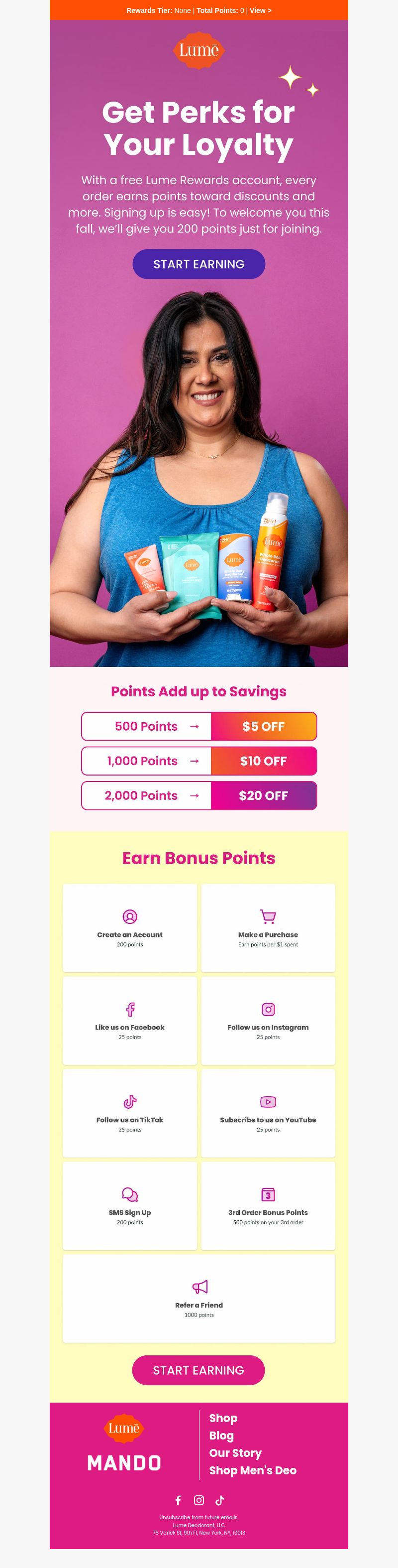
Progress cues matter. Tier movement, points accumulation, early access windows, and milestone recognition all create a sense of forward motion. Even small acknowledgments can reinforce that staying engaged has benefits beyond saving money.
The goal isn’t to train customers to wait for deals. It’s to make loyalty feel earned, visible, and worth maintaining.
9. Feedback emails turn listening into retention
Feedback emails are often treated like a formality. They shouldn’t be.
When timed well, they:
Prevent churn
Improve future experiences
Make customers feel heard

Keep requests short. Ask while the experience is fresh. And close the loop by showing how feedback influences decisions. Listening builds loyalty faster than any promotion.
10. Promotional emails still matter, but relevance sets the ceiling
Promos drive revenue. That hasn’t changed.
What has changed is tolerance. Generic promotions sent to everyone get ignored faster than ever. Segmentation and timing now determine whether a promo feels helpful or intrusive.
Smarter promo strategy means:
Fewer sends, better targeting
Honest urgency
Clear value without pressure
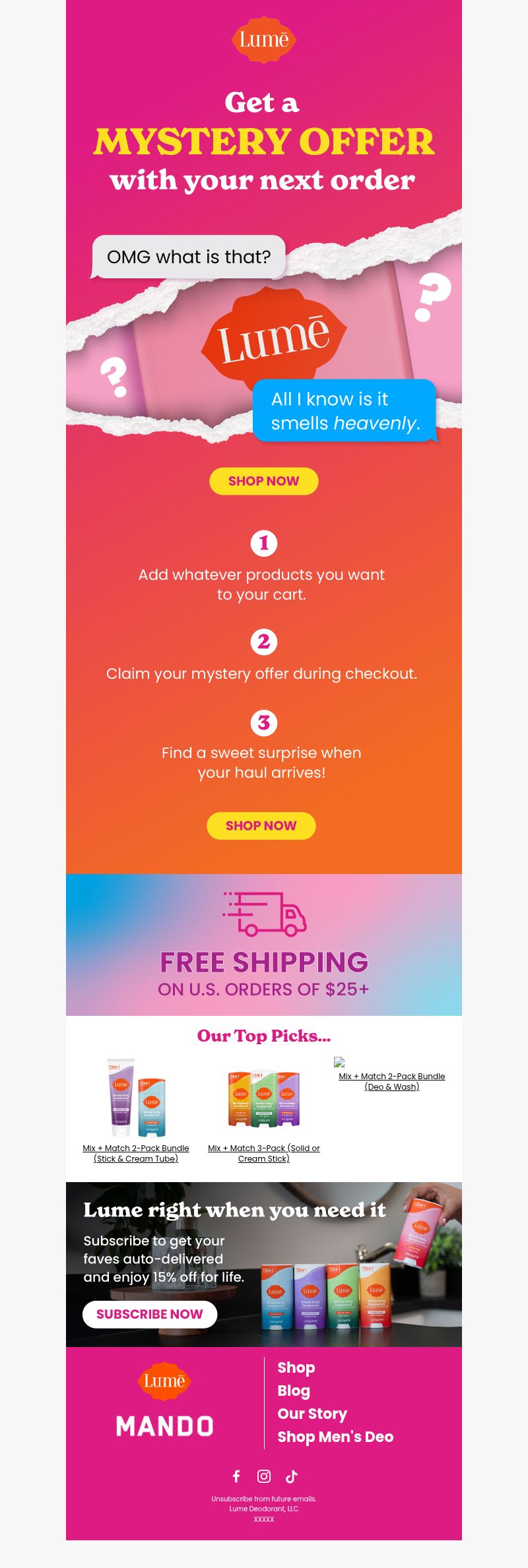
If every email is a sale, none of them feel special.
11. Transactional emails are trust builders, not ad space
Order confirmations, shipping updates, and account alerts are some of the most-opened emails you send. They also sit in a more protected category in the inbox, which means inbox providers like Gmail pay close attention to how they’re used.
That matters more now than ever.
Gmail’s newer guidelines draw a clearer line between transactional and promotional content. When transactional emails start behaving like marketing emails, heavy upsells, multiple CTAs, or aggressive cross-sells, they can lose that protected status. Over time, that can impact inbox placement across your entire program.
Transactional emails should:
Deliver information clearly and quickly
Reduce anxiety around orders, shipping, and returns
Reinforce reliability and support, not urgency

Think of transactional emails as reputation builders. When they’re calm, clear, and respectful, they signal trust to both customers and inbox providers.
Email still works. The margin is in the decisions
The difference in 2026 isn’t who sends the most emails.
It’s who knows when to send, when to wait, and when to stop.
Every email is a decision. And the brands that treat it that way build stronger lists, healthier deliverability, and longer-lasting revenue.
Email hasn’t lost its power.
It just rewards better judgment now.
Knowledge drop:
Can’t win on price or distribution? Jimmy shares three moats (knowledge, service, and story) that help smaller brands outteach, outcare, and outstory the giants.
DTC wins:
Cymbiotika popped off the new year with a bang, launching Advanced Creatine; a single-serve liquid formula with 5g of CreaBev® creatine monohydrate, 21% better absorption, and a tangerine-vanilla flavor.

Annnnd that’s a wrap for this edition!
Thanks for hanging with Chase and me, always a pleasure to have you here.
If you found this newsletter helpful (or even just a little fun), don’t keep it to yourself! Share ecomemailmarketer.com with your favorite DTC marketer. Let’s get them on board so they don’t miss next week’s drops.
Remember: Do shit you love.
🤘 Jimmy Kim & Chase Dimond
PS - Your next best customer might be reading this right now. Want in? Email Jimmy to sponsor this newsletter and more.
Love this newsletter but want to receive it less frequently? Let us know by clicking here!
Reply