- eCom Email Marketer
- Posts
- Thu 9/3 | Ed 407 | How many Black Friday emails is too many?
Thu 9/3 | Ed 407 | How many Black Friday emails is too many?
🌊 Every Commerce Roundtable has sold out. San Diego will too. Lock in your spot before all 750 tickets are gone. → Use code EEMVIP for 40% off
We spent some time digging through last November’s inbox this week, and two brands stood out for completely different reasons.
Blume sent 35 Black Friday emails. Shinola sent 27, with plenty of campaigns getting a second send. Both locked in their offer early, which left them with the same problem: three weeks of Black Friday left and not much new to say.
What they did with those three weeks is where things get interesting, because they went in completely opposite directions. This morning we're breaking it all down.
Also inside:
→ Where the people who do this for a living actually learned it
→ Someone with no stake in your Black Friday email will read it out loud
→ A drive-thru coffee chain in a can, Gap’s second golf collab, and twice the caffeine in an iced tea bottle
Most of us picked up retention by inheriting somebody else’s ESP and working it out from the inside, which holds up fine right until someone asks you to defend a decision.
eCom Email Certified walks you through step-by-step. 175+ lessons across flows, campaigns, segmentation, deliverability, AI, and copywriting, and a certification at the end that means something to a client or a hiring manager.
It’s normally $997, but SAVE500 brings it down to $497.
That’s less than $500 for the retention education most of us had to piece together over years of trial, error, and inherited accounts.
By the second week of a Black Friday sale, everybody who was waiting for it has already bought.
The offer hasn’t changed, the deadline’s still ten days out, and there’s another dozen sends sitting on the calendar with nothing new to put in them. That’s the hard part of running a month-long sale, and it’s the part nobody plans for in September.
Blume and Shinola both hit that wall last November and went in opposite directions with it. One changed who was doing the talking. The other changed who you were shopping for.
Blume: Give people a new reason to look, not a new discount
Subject line: We’re doing Black Friday early ❤️
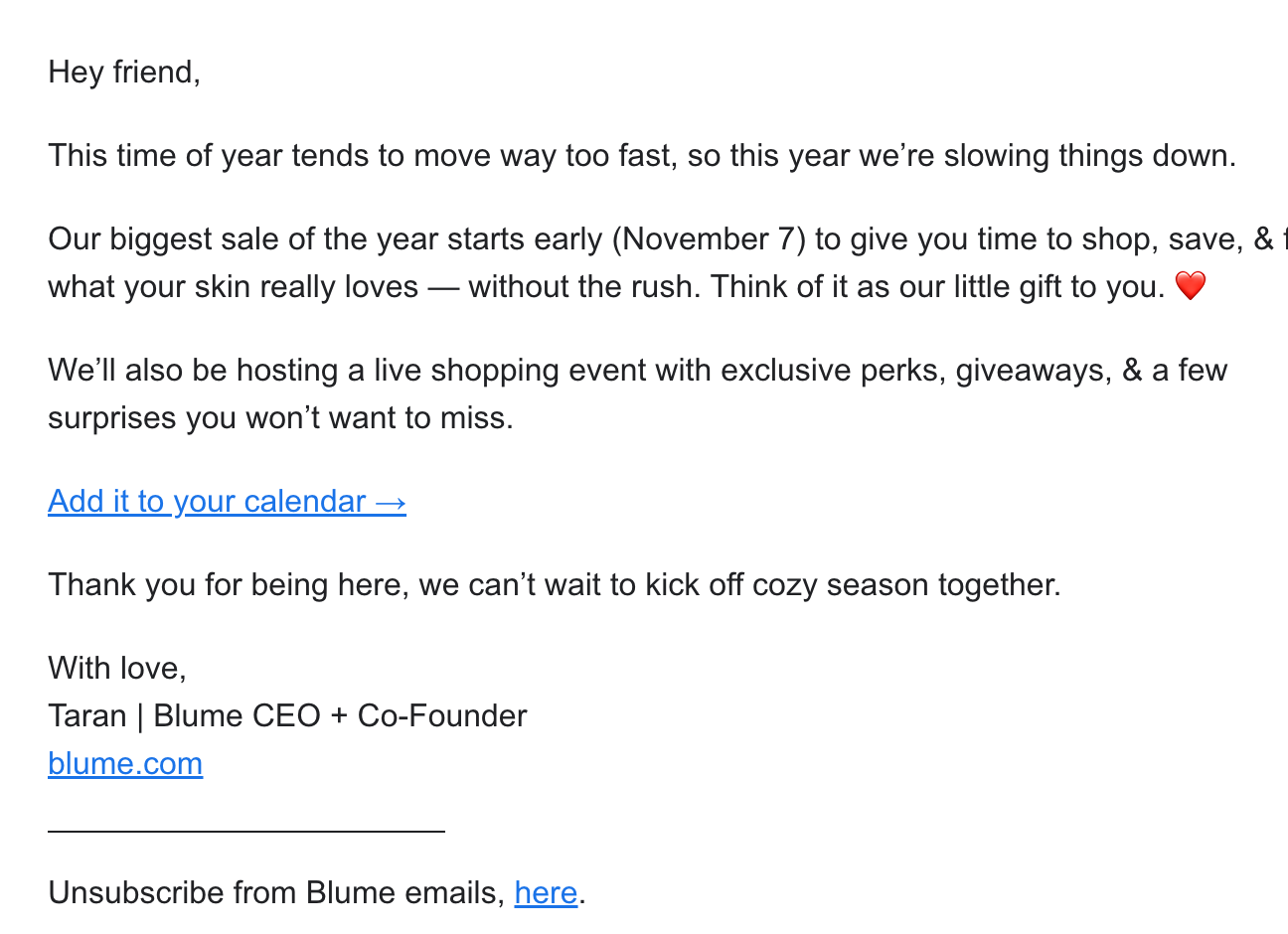
Blume starts two days before the sale does, with a letter from Taran, who’s the CEO. “This time of year tends to move way too fast, so this year we’re slowing things down.” The sale opens November 7, and the reason she gives for going early is your calendar, not theirs.
Then the offer doesn’t move for twenty-four days. Up to 50% off sitewide, November 7 to December 1, same deal the whole way through.
What moves is everything around it:
Three people signing the emails, not one brand. Taran writes the sincere ones. Bunny, the COO, does the live shopping and the inventory panic (“okay but why is everything selling out”). Ariel handles the free-gift sends.
The events are the news. Two live shopping sessions, the first at 5:30 PM PST on November 12, with over $500 in giveaways and a free gift you could only get during the stream.
The calendar keeps handing them sends. A gift guide, gifts under $40, Small Business Saturday, Giving Tuesday with all the profits donated. None of it touches the discount.
The best one lands Thanksgiving morning at 8am. Taran again, saying thanks, and then this: they’re fully refunding ten random orders placed that day. “No sign-ups, no extra steps.” It costs them ten orders and it buys a send on the one morning nobody else has anything to say.
Where it gets heavy is the filler. Three or four of those 35 don’t do anything except tell you the sale’s still on, and they’re sitting right next to the ones that have something in them. Cut those and you lose nothing.
What brands can take from it:
If the offer’s locked for a month, what you’re actually scheduling is reasons to look. A live session, a giveaway, a restock note, a founder writing on a holiday morning. Every one of those earns a send that “up to 50% off” wouldn’t.
Shinola: Sell one offer and change who it’s for
Subject line: 12 Days of Giving starts now
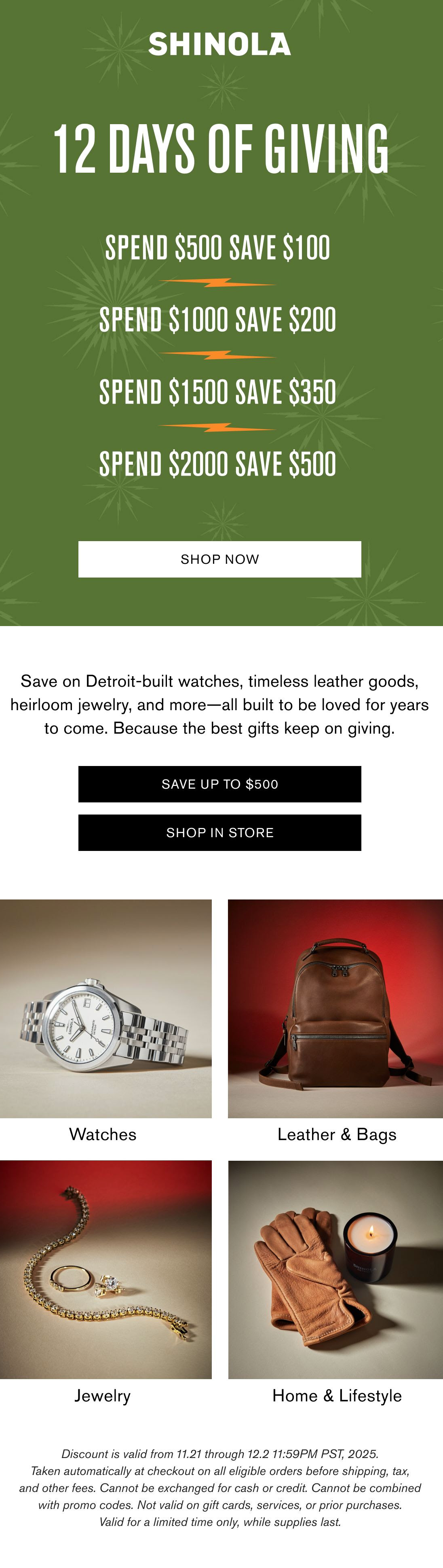
Shinola never puts a percentage in front of you. The whole thing runs on a spend threshold: spend $500 save $100, spend $1,000 save $200, spend $1,500 save $350, spend $2,000 save $500. Underneath it, “Save on Detroit-built watches, timeless leather goods, heirloom jewelry, and more, all built to be loved for years to come.”
Work the math and the discount gets better as the basket does, 20% at the bottom rung and 25% at the top, so the biggest break goes to the biggest order instead of to somebody buying one keychain.
Three things that buys them:
The campaign name beats the holiday. Everything from November 21 to December 2 sits inside “12 Days of Giving.” Black Friday is one email in it, and it doesn’t bring a new offer with it.
The recipient does the segmenting. “Our Most-Loved Gifts for Her,” “These Men’s Best-Sellers Do the Talking,” “Gifts with a pulse,” “Gifts That Carry a Heartbeat.” Same ladder under all four.
Every send goes out twice. The opener went at 6:06 AM and again at 4:03 PM the same day, and a few other pairs are identical except for punctuation, a period on one and none on the other.
What they got wrong is that the offer only exists inside a picture. Turn images off, which a lot of people and most corporate mail clients do, and the whole ladder goes with it, button included. Put those four tiers in live text under the graphic and the email still works in Outlook and on a train.
What brands can take from it:
A spend threshold protects your margin in a way sitewide percentage off can’t, and calling the campaign something other than Black Friday buys you two more weeks of sends that still make sense on December 2.
The part both of them got right
Neither one spent November arguing about the discount. They settled it early, left it alone, and put the rest of the month into why you’d look today. Blume went to the people who run the company. Shinola went to whoever you’re buying the gift for.
Run Blume’s version when:
Your founders will actually get on camera or write in their own voice
You’ve got giveaways, bundles or inventory news to spend
The list hears from you a lot already and won’t flinch at a send a day
Run Shinola’s version when:
Margin matters more than volume and AOV is the number you’re moving
The catalog splits cleanly by who the gift is for
You’d rather build one campaign properly and put it in front of everyone twice
Either one works. What doesn’t is the version most of us have shipped at some point, where the offer’s the only thing in the email and days three through eleven are that same email with the subject line in caps.
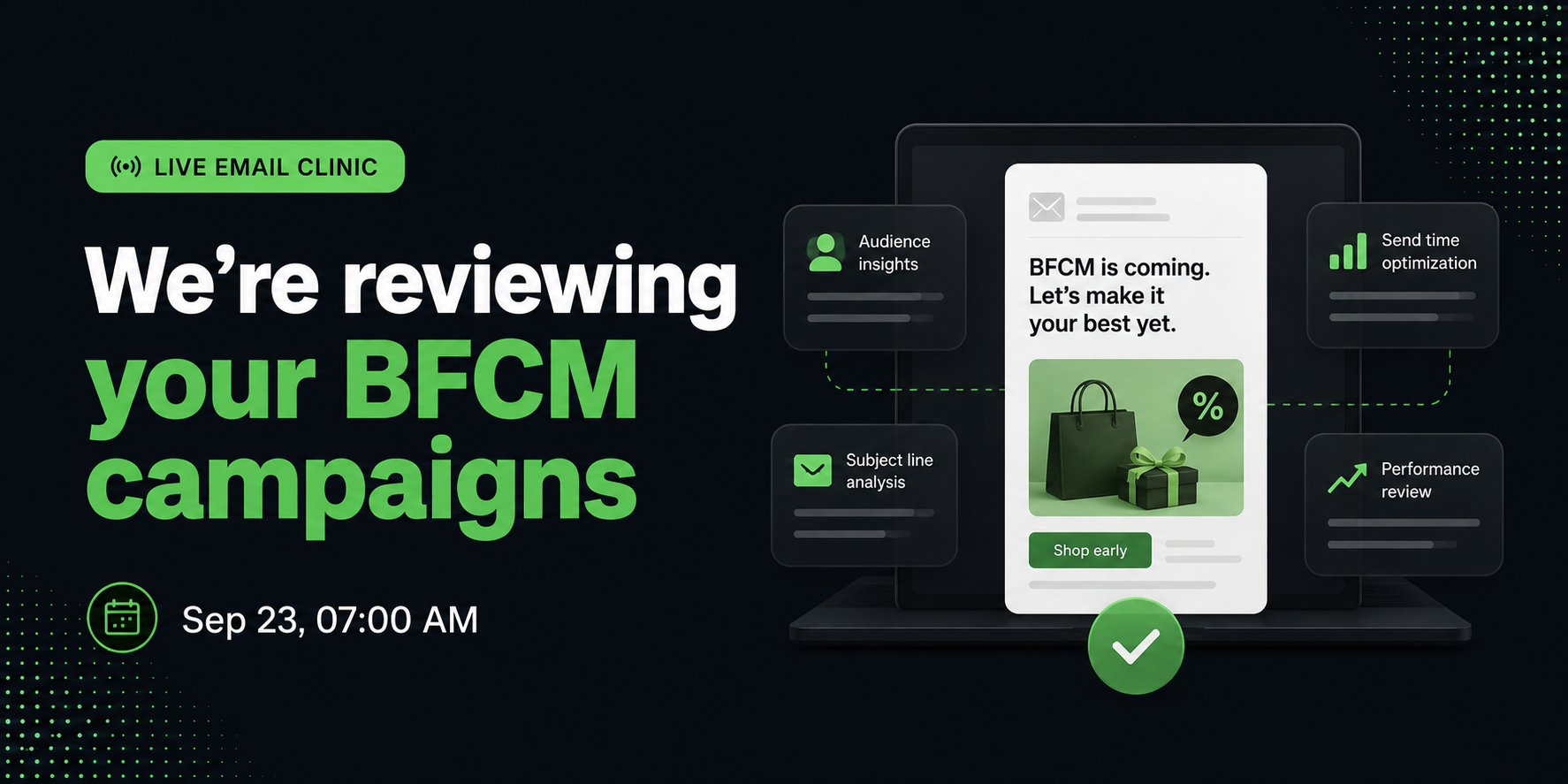
By late September your Black Friday send is written, approved and sitting in a folder, and the only people who’ve looked at it are the two who wrote it and the one who said “looks good.”
Omnisend’s running a live email clinic on September 23 where they’ll pull real BFCM campaigns up on screen and go through them properly: subject line, offer, what order things sit in, where the send quietly loses people.
Worth half an hour for a set of eyes that had nothing to do with writing it.
*Sponsored
7 Brew put its drive-thru menu in a can at 4,400 Walmarts
7 Brew spent five years building a following at drive-thru stands, and on August 22 it started selling the same drinks to people who never pull into one. Canned coffee at $2.98 in roughly 4,400 Walmarts, plus five energy SKUs at $2.48 in 1,100 of them.
Gap and Malbon went back in for a second round
Their second collection together since 2025 landed August 21 on Gap and in 18 stores, 35 pieces running $28 to $250. Rugby polos, pleated skirts, prep knits and a short run of golf accessories.
Saint James put a cup and a half of coffee in an iced tea bottle
Five years in, Saint James has its first product extension, and it’s yerba mate, in Mango Passionfruit, Raspberry Lemon and Strawberry Tangerine. Each bottle carries 150mg of caffeine, about double a typical mate, at $39.99 a 12-pack.
Reply