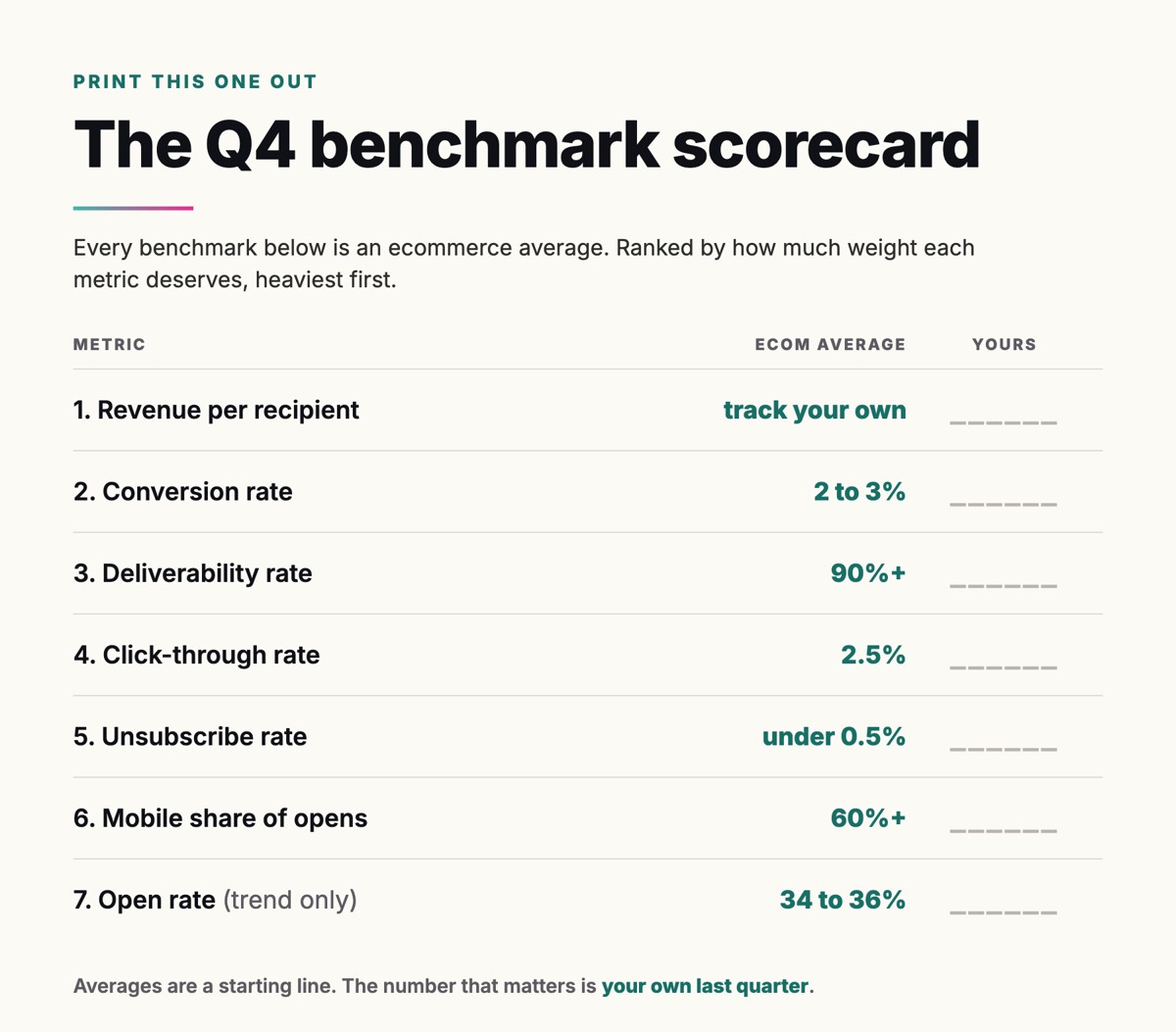
Your open rate has been lying to you since 2021, and in Q4 that lie gets expensive.Apple’s Mail Privacy Protection preloads your tracking pixel whether anyone reads the email or not, so a chunk of your "opens" are a machine, and the number you’ve been reporting to your boss is inflated by design. Today we’re running the 7 metrics that still tell the truth, what each one actually measures, the formula, and the benchmark worth holding yourself to before your Q4 sends start. Also inside → The month your welcome flow pays you back, and how to find it → A scorecard worth printing: the 7 numbers and where yours should land → The brand that opened an Amazon store and kept the good stuff at home → 50 campaigns, 130+ welcome flows, and the price of a lunch
|
The breakdown The 7 email metrics that still tell you the truthYou don’t need a data science degree to know whether email is working. You need 7 numbers, and most teams track 2 of them. We’ve ordered these by how much weight they deserve, heaviest first, and each one comes with what to actually do this week. The metric everybody opens their report with is last, and there’s a good reason for that. 1. Revenue per recipientRPR = total email revenue / emails delivered The number that turns email into a business case, and the only one here a CFO already understands. It survives every tracking problem below it, because the denominator is a send rather than a behaviour. Revenue per open is the same idea with a dirtier denominator. ✓ Pull RPR for your last 10 campaigns and sort them high to low ✓ Look at the bottom 3 and check the segment before you blame the copy ✓ Quote RPR, not total revenue, the next time you ask for budget
2. Conversion rateConversion rate = (conversions / emails delivered) x 100 Opens and clicks are interest. This is the one that pays. Ecommerce averages sit around 2 to 3%, and a low number usually lives after the click: a slow checkout, no social proof, or a price the email never prepared anyone for. ✓ Click your own CTA on a phone and count the taps to checkout ✓ Compare the promise in the subject line to the first line on the landing page ✓ Put the price in the email when the product is over $75, so nobody meets it for the first time at checkout
3. Deliverability rateDeliverability = (emails delivered / emails sent) x 100 This one sits above everything else, because every number below it is multiplied by zero when you land in spam. Top senders hold above 90%. Below 80% and you have a list hygiene problem, not a copy problem, and Q4 is the worst possible week to find that out. ✓ Segment everyone who has not opened in 90 days and stop mailing them until they come back ✓ Run a 2 email win back at that group now, not in December ✓ Check your bounce rate per campaign, and if it is over 2% the list is the problem
4. Click-through rateCTR = (total clicks / emails delivered) x 100 The first number that reflects a real human choosing to act. Ecommerce averages land around 2.5%, so 1% points at the offer, the design, or a CTA nobody can find. ✓ Switch your reporting to clicks per opener, which answers the question open rate used to ✓ Count the CTAs in your last campaign, and if the answer is 1, add a second above the fold ✓ Pull your top 3 clicked links of the quarter and send more of whatever they were
5. Unsubscribe rateUnsub rate = (unsubscribes / emails delivered) x 100 0.5% is the healthy ceiling. Double it and the usual causes are frequency, irrelevance, or a subject line that promised something the email never delivered. ✓ Chart unsubs per campaign, not per month, so you can see which send did it ✓ Add a cadence preference link next to the unsubscribe link before Q4 volume climbs ✓ If one segment is driving the number, suppress it from promos rather than mailing harder
6. Mobile share of opensMobile share = (mobile opens / total opens) x 100 More than 60% of ecommerce email is opened on a phone. It sits down here because it is a design check rather than a performance number, but if mobile conversion is well under desktop, the email is failing on the screen most people read it on. ✓ Send yourself the next campaign and read it one handed, outside, in daylight ✓ Make every tap target at least 44px tall ✓ Put the offer in text above the hero image, so it lands before anything loads
7. Open rate, and why it’s lastOpen rate = (total opens / emails delivered) x 100 Since Apple’s Mail Privacy Protection landed in 2021, Apple Mail preloads email content, tracking pixel included, whether or not a human opened anything. Apple Mail is a huge share of opens, so a meaningful chunk of your open rate is a machine. That doesn’t make it useless. It makes it a trend line for subject lines and sender reputation, and nothing you should be setting targets against. Everything above it is harder to fake. ✓ Stop reporting open rate as a result, and report clicks per opener instead ✓ Keep watching it for sudden drops, which signal deliverability before anything else does ✓ If a target in your plan is written as an open rate, rewrite it as revenue per recipient
Steal thisPick the top 3 on this list, write down today’s number for each, and put the same 3 in front of your team every Monday through Q4. The point isn’t the dashboard, it’s noticing the week a number moves and knowing which send moved it. |
The DTC scoop: Hanna Andersson opened an Amazon store and kept the good stuff at homeThe kids apparel brand launched its Amazon storefront on October 1, and 90% of what’s in there is unique to Amazon: mostly archived best sellers, playwear and sleepwear. The 60+ new family pajama prints stay exclusive to its own site, per Modern Retail. CEO Aimée Lapic framed it as reaching a parent who needs something right now. That’s assortment as a CRM strategy. Amazon buys the first transaction, and the emotional, higher margin SKUs stay where email and SMS can actually sell them. Litter-Robot is doing TikTok Shop without the discountWhisker is selling its $699 automated litter box on TikTok Shop and holding price while the platform trains everyone to expect a deal, per Modern Retail. CMO Hew Loyd calls the self cleaning mechanism a thumb stopper, and the viral content lifts sales on their own site and Amazon too. The part worth stealing is what happens after the sale: they push TikTok Shop buyers into the app to recover first party data, instead of writing off a whole cohort as unreachable. Nest turned its bestselling candle into a perfumeNest New York is launching Wonder, an eau de parfum built from the scent of its Holiday candle, with patchouli and spice making it its own thing rather than a copy, per Glossy. Fine fragrance went from 40% of launches in 2025 to 75% this year, and the perfume oils doubled that business in 9 months instead of the 3 years they planned for. Everyone who ever bought the Holiday candle is a pre qualified list for a higher AOV product. That’s the highest intent cross sell email you will send this quarter. |
Reply